
LEADS, identifies five interdependent dimensions of effective educational leadership, emphasizing judgment, coherence, and responsibility rather than technical skill or compliance.
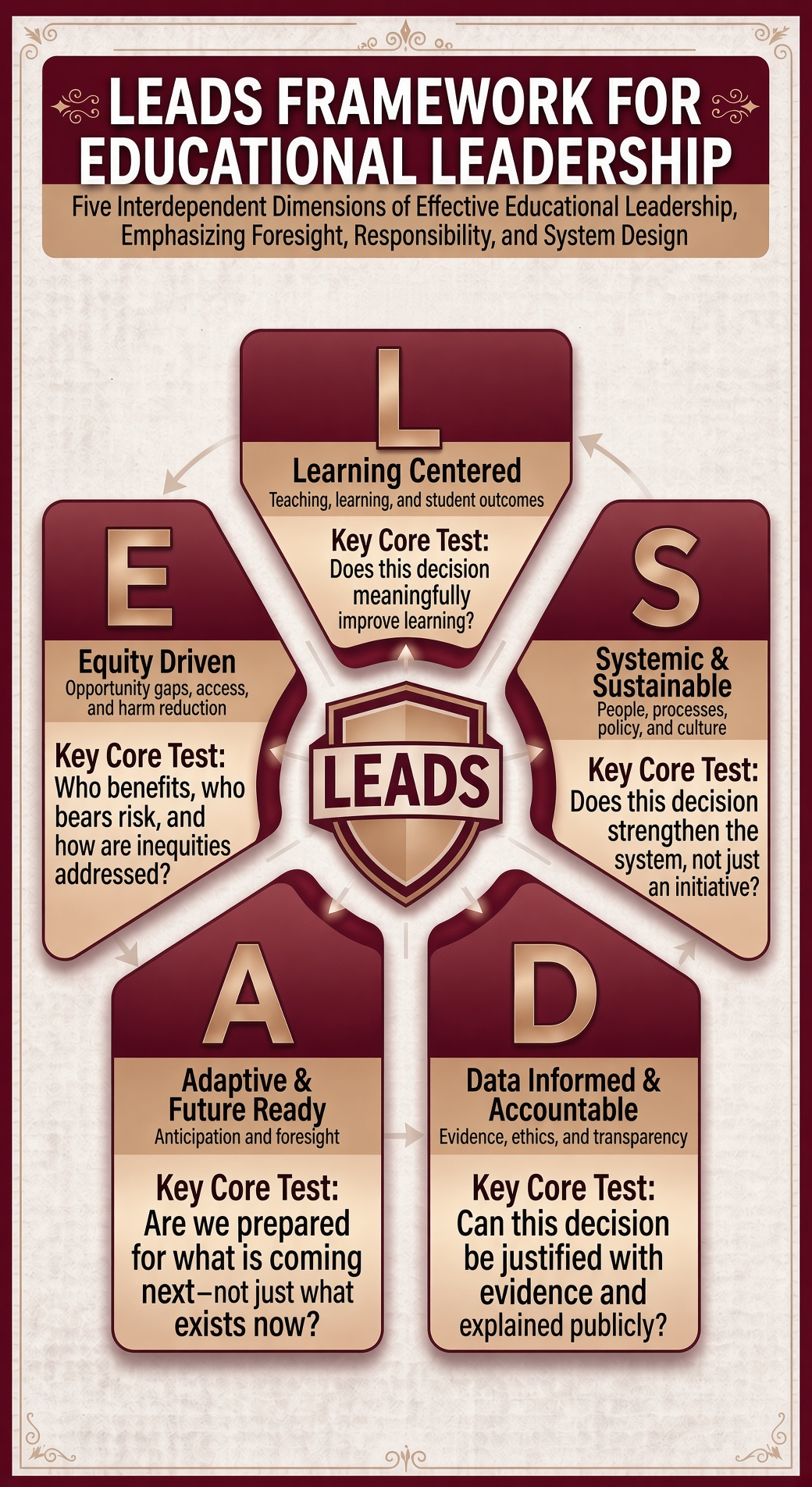
LEADS supports ELA learning experiences
LEADS, identifies five interdependent dimensions of effective educational leadership, emphasizing judgment, coherence, and responsibility rather than technical skill or compliance.
| Dimension | Description | Key Question |
|
L Learning-Centered Leadership |
Leaders focus relentlessly on learning as the core purpose of the organization. • Prioritize instructional quality over tools or initiatives. • Evaluate decisions by their impact on teaching and learning. • keep student learning, not programs or platforms, at the center. |
How does this decision improve learning? |
|
E Equity-Driven Leadership |
Leaders recognize that fairness requires differentiation, not sameness. • Attend to opportunity gaps and structural inequities. • Design systems that are responsive to context. • Embed equity in leadership decisions. |
Who benefits, who bears risk, and who is left out? |
|
A Adaptive and Future Ready Leadership |
Leaders anticipate and prepare for change in a rapidly evolving digital environment. • Monitor emerging technologies (e.g., AI, cybersecurity, data systems). • Plan proactively rather than reacting to technological shifts. • Build organizational capacity to adapt over time. • Position the system to respond to future educational and workforce demands. |
Can I explain and defend this decision publicly? |
|
D Data-Informed Leadership |
Leaders use data as a tool for judgment, not a substitute for it. • Interpret data in context. • Combine quantitative and qualitative insight. • Avoid metric overreliance. |
|
|
S Systemic and Sustained Leadership |
Leaders think beyond initiatives toward what endures. • Build systems that sustain over time. • Consider capacity and coherence. • Balance innovation with sustainability. |
Will this still hold five years from now? |
Applied Practice
| Scenario | Learning Centered |
Equity Driven |
Adaptive & Future Ready |
Data Informed & Accountable |
Systemic & Sustainable |
|
1. Declining Student Achievement Three years of declining mathematics performance prompt district leaders to consider curriculum, professional learning, and intervention changes. |
Which proposed actions are most likely to improve student learning and outcomes? | Which groups of students are most affected, and how will solutions address disparities? |
How do proposed strategies prepare students and educators for future learning demands? | What evidence supports the need for change, and how will success be measured? | How can the district build sustainable structures that support long-term improvement? |
|
2. Budget Reductions and Resource Allocation State funding declines require difficult decisions regarding staffing, programs, and operations. |
How will budget decisions affect teaching, learning, and student outcomes? | Which students or schools may be disproportionately affected by reductions? | How can resources be aligned to future priorities despite fiscal constraints? | What financial and performance data should inform allocation decisions? | How can leaders preserve essential programs while maintaining system stability? |
|
3. Teacher Recruitment and Retention Challenges The district faces shortages in key areas and increasing educator turnover. |
How does teacher retention influence learning quality and student success? | Which schools and student groups are most affected by staffing shortages? | What innovative workforce strategies can strengthen the future talent pipeline? | What workforce data help identify root causes of turnover and staffing gaps? | What organizational systems must change to support long-term recruitment and retention? |
|
4. School Improvement Initiative A school implements a plan to improve engagement and reduce chronic absenteeism, with mixed early results. |
How is the initiative influencing student engagement and learning experiences? | Are all student groups benefiting equally from the improvement efforts? | How should leaders adjust the initiative based on emerging challenges and opportunities? | What evidence demonstrates progress, and what additional information is needed? | How can improvement efforts become part of the school's ongoing culture and practices? |
|
5. Leadership Transition and Organizational Change A new superintendent introduces a revised strategic plan that reshapes district priorities and structures. |
How do the proposed changes support improved learning outcomes? | How will the transition affect different stakeholder groups across the district? | How can leaders balance current needs with future strategic priorities? | What evidence supports the new direction, and how will progress be monitored? | How can district leaders maintain organizational coherence during the transition? |
Benoliel, P., & Schechter, C. (2024). Organizational resilience and transformational leadership for managing complex school systems. Frontiers in Education, 9, Article 1333551. https://doi.org/10.3389/feduc.2024.1333551
Carter, V. C., Jr. (2021). Culturally responsive school leadership: A review of the research. Region 10 Comprehensive Center. https://files.eric.ed.gov/fulltext/ED624386.pdf
Coburn, C. E., & Turner, E. O. (2011). Research on data use: A framework and analysis. Measurement: Interdisciplinary Research and Perspectives, 9(4), 173–206. https://doi.org/10.1080/15366367.2011.626729
Day, C., Gu, Q., & Sammons, P. (2016). The impact of leadership on student outcomes: How successful school leaders use transformational and instructional strategies to make a difference. Educational Administration Quarterly, 52(2), 221–258. https://doi.org/10.1177/0013161X15616863
Gooden, M. A., Khalifa, M., Arnold, N. W., Brown, K. D., Meyers, C. V., & Welsh, R. O. (2023). A culturally responsive school leadership approach to developing equity-centered principals. Wallace Foundation/WestEd. https://wallacefoundation.org/sites/default/files/2023-07/Culturally-responsive-school-leadership-approach_06.29.FINALforposting.pdf
Grissom, J. A., Egalite, A. J., & Lindsay, C. A. (2021). How principals affect students and schools: A systematic synthesis of two decades of research. The Wallace Foundation. https://www.wallacefoundation.org/knowledge-center/Documents/How-Principals-Affect-Students-and-Schools.pdf
Hallinger, P. (2011). Leadership for learning: Lessons from 40 years of empirical research. Journal of Educational Administration, 49(2), 125–142. https://doi.org/10.1108/09578231111116699
Hargreaves, A., & Fink, D. (2006). Sustainable leadership. Jossey-Bass.
Karacabey, M. F., Bellibaş, M. Ş., & Adams, D. (2022). Principal leadership and teacher professional learning in schools: Examining the mediating effects of collective teacher efficacy and teacher trust. Educational Studies, 48(2), 253–272. https://doi.org/10.1080/03055698.2020.1749835
Katsikas, A. (2025). Leadership style in education: Advantages and challenges. International Electronic Journal of Elementary Education, 17(3). https://files.eric.ed.gov/fulltext/EJ1476410.pdf
Khalifa, M. (2024). Culturally responsive school leadership: Emerging trends and future possibilities. Spencer Foundation. https://spencerfoundation.org
Lee, C., Camburn, E. M., & Sebastian, J. (2025). School context, school leaders’ data-informed decision making, and student achievement: Evidence from Florida. School Effectiveness and School Improvement, 36(1), 45–70. https://doi.org/10.1080/09243453.2024.2436889
Liu, K., Tschinkel, R., & Miller, R. (2024). Digital equity and school leadership in a post-digital world. ECNU Review of Education, 7(3), 762–783. https://doi.org/10.1177/20965311231224083
Louis, K. S., Leithwood, K., Wahlstrom, K., & Anderson, S. (2010). Learning from leadership: Investigating the links to improved student learning. The Wallace Foundation. https://wallacefoundation.org/sites/default/files/2023-10/Investigating-the-Links-to-Improved-Student-Learning.pdf
Mandinach, E. B., & Gummer, E. S. (2013). A systemic view of implementing data literacy. Educational Researcher, 42(1), 30–37. https://doi.org/10.3102/0013189X12459803
Marshall, S. L., & Galey-Horn, S. (2024). STEM leaders promoting resilience within equity-centered K–12 STEM education organizations. Frontiers in Education, 9, Article 1331358. https://doi.org/10.3389/feduc.2024.1331358
Ming, G. K., Mansor, M., & Fuad, D. R. S. M. (2024). Data-driven decision-making in educational leadership: A systematic literature review (2019–2023). Pakistan Journal of Life and Social Sciences, 22(2), 18863–18872. https://www.pjlss.edu.pk/pdf_files/2024_2/18863-18872.pdf
Peng, Y., Alias, B. S., Wan, X., & Mansor, A. N. (2024). The impact of sustainable leadership on education quality: A systematic review. Journal of Law and Sustainable Development, 12(6), Article e03760. https://doi.org/10.55908/sdgs.v12i6.3760
Robinson, V. M. J., Lloyd, C. A., & Rowe, K. J. (2008). The impact of leadership on student outcomes: An analysis of the differential effects of leadership types. Educational Administration Quarterly, 44(5), 635–674. https://doi.org/10.1177/0013161X08321509
Sandoval-Ríos, F., Gajardo-Poblete, C., & López-Núñez, J. A. (2025). Role of data literacy training for decision-making in teaching practice: A systematic review. Frontiers in Education, 10. https://doi.org/10.3389/feduc.2025.1485821
Sebastian, J., Allensworth, E., Wiedermann, W., Hochbein, C., & Cunningham, M. (2019). Principal leadership and school performance: An examination of instructional leadership and organizational management. Leadership and Policy in Schools, 18(4), 591–613. https://doi.org/10.1080/15700763.2018.1513151
Senge, P. M. (2006). The fifth discipline: The art and practice of the learning organization (Rev. ed.). Doubleday.
Shields, C. M. (2010). Transformative leadership: Working for equity in diverse contexts. Educational Administration Quarterly, 46(4), 558–589. https://doi.org/10.1177/0013161X10375609
Shoib, N. A. M., Talip, R., & Sukor, N. (2026). School governance and educational leadership for sustainable school improvement: A systematic literature review. International Journal of Research and Innovation in Social Science. https://doi.org/10.47772/IJRISS.2026.100600360
Note: